
Christian Acrylic Wall Art: The Complete Buying Guide

Table of Contents
- Why Christian Acrylic Wall Art Belongs in a Modern Home
- Bible Verse Wall Art: Choosing Scripture That Fits the Room
- Christian Wall Decor Ideas for Every Space
- How to Hang Acrylic Wall Art Without Damaging Your Walls
- How to Clean Acrylic Wall Art and Keep It Looking New
- Sizing, Lighting, and Placement: Getting the Details Right
- Conclusion
- Frequently Asked Questions
Last Updated: October 18, 2026
Why Christian Acrylic Wall Art Belongs in a Modern Home
Christian acrylic wall art is a frameless panel of optical-grade acrylic with scripture or faith imagery UV printed directly into the surface, producing a glossy, glass-like piece that appears to float off the wall.
That difference changes how a verse reads across a room: muted on stretched fabric, sharp and deliberate on a polished panel.
Below, we break down what separates acrylic from canvas and framed prints, how to pick scripture for a room, where to hang each piece, and how to care for it.
What Makes Acrylic Different from Canvas and Framed Prints
Three things separate acrylic from the alternatives: the printing method, the absence of a frame, and the way light behaves on the surface.
- Printing: UV printing bonds pigment directly to the acrylic face rather than laying ink on a woven substrate. There is no paper, no canvas texture, and no glass covering the image.
- Construction: The panel is frameless with polished edges. Hidden mounting hardware holds it slightly off the wall, which creates the floating effect and a soft shadow line.
- Light behavior: Optical-grade acrylic reads brighter and more saturated than canvas under the same lighting. It also reflects ambient light, which is why placement matters more than it does for a matte print.
Bible Verse Wall Art: Choosing Scripture That Fits the Room
The most common mistake with Bible verse wall art is choosing the verse you love most rather than the verse the room needs.
Start with the room's emotional job.
Read the verse in context before you commit. That context makes it stronger and fits a season of patience rather than launch. Our Hope And A Future panel leans into that reading.
Christian Wall Decor Ideas for Every Space
Christian wall decor ideas work best when the piece is sized and placed for the room's traffic pattern rather than centered by default. A verse above a sofa, beside a door, and behind a squat rack are three different design problems.
Living Rooms, Entryways, and Bedrooms
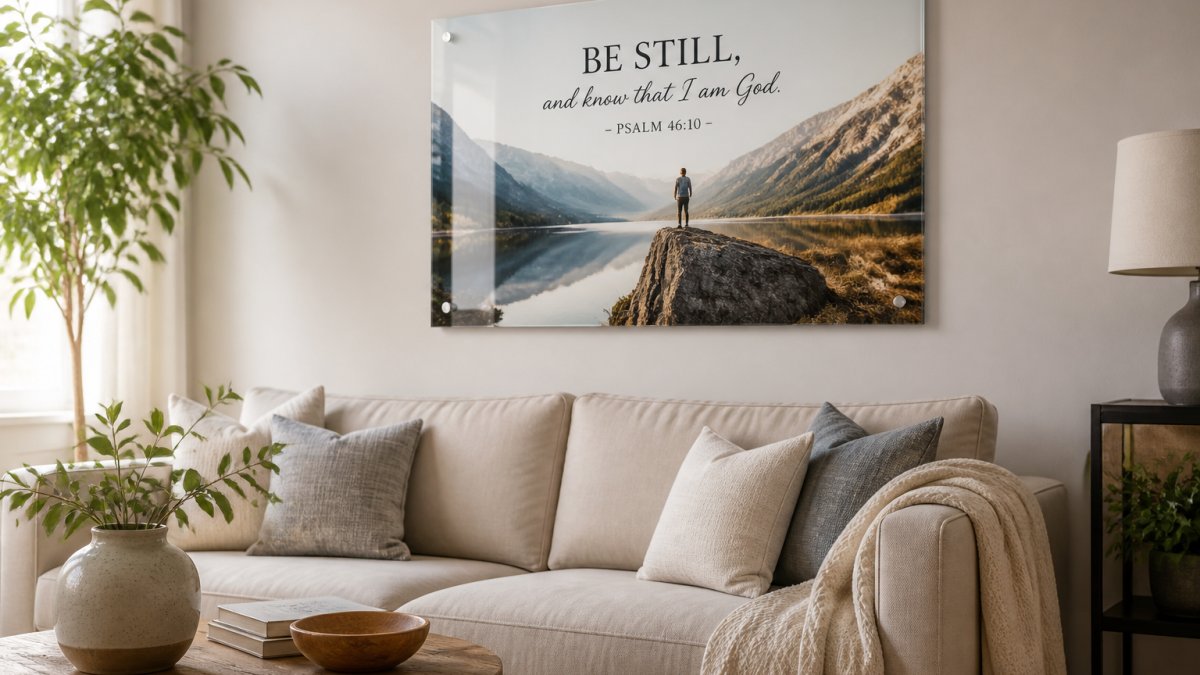
In a living room, center the panel at eye level for a standing adult, roughly 57 to 60 inches from the floor, and leave 6 to 10 inches between the sofa backrest and the bottom edge.
Entryways reward a verse you see on the way out. Joshua 1:9 fits here, and our Go Anyway panel was built around it. Bedrooms want restraint.
Offices, Home Gyms, and Church Spaces
Home gyms and offices have a different brief: the art should push, not soothe. Philippians 4:13 ("I can do all this through him who gives me strength") is the obvious pick for a gym, and it earns its place. Our Strength For This panel treats the line as a statement rather than a slogan.
For a home office, entrepreneur wall art acrylic pieces work when they sit in the sightline of the desk, not behind the chair. You want to catch the words when you look up, not when you turn around.
How to Hang Acrylic Wall Art Without Damaging Your Walls
Hanging acrylic wall art comes down to one rule: let the hardware do the work, and keep the panel level before you commit. Our panels ship with hidden mounting hardware and arrive ready to hang, so the job is placement, not assembly, but frameless acrylic behaves differently from a framed canvas, and the details are where most hangings go wrong.
Understand what the hardware is doing
A frameless acrylic panel uses a standoff or cleat system that holds the back a fraction of an inch off the wall, producing the floating effect and soft shadow line. The load is carried at a few discrete points rather than across a frame rail, so the anchors, not the panel, are the weak link. Match the anchor to the wall, not the artwork.
- Drywall with wood studs: Lag bolts or heavy-duty toggle bolts into studs are the most secure option. If the mounting points do not land on studs, use toggle bolts rated well above the panel's weight.
- Drywall without studs at the mount points: Self-drilling drywall anchors work for lighter panels; snap-toggle anchors are the safer choice as panel size climbs.
- Plaster and lath: Older plaster can crumble around a drill bit. Drill a small pilot hole, expect some breakout, and prefer anchors with a wide collar that spreads load across the plaster skin.
- Masonry, brick, and concrete: Use masonry anchors or sleeve anchors. A standard drill is not enough, you need a hammer drill and the correct bit.
The hanging sequence that avoids re-drilling
- Confirm the wall substrate before choosing anchors. Tap the wall and look for studs with a stud finder; do not guess.
- Mark the mounting points with painter's tape, hold the panel in place, and step back to check height and level, a second set of eyes helps, since a panel level from two feet away can read crooked across the room.
- Drill, set anchors, and mount the hardware before the panel goes up.
- Leave the protective film on until the piece is mounted, then remove it, wipe the face, and check the shadow line.
- Confirm the wall is drywall, plaster, or masonry before choosing anchors
- Mark mounting points with painter's tape and check level
- Hold the panel in place and step back before drilling
- Leave the protective film on until the piece is mounted
- Remove film, wipe the face, and check the shadow line
If you are placing a piece in a hallway where people brush past, say a Go Anyway panel near a mudroom door, give the bottom edge a little extra clearance so shoulders and bags do not catch the corner.
How to Clean Acrylic Wall Art and Keep It Looking New
Cleaning acrylic wall art takes two minutes and one rule: never use a dry cloth on a dry surface. Dust with a soft microfiber cloth, wipe with a slightly damp cloth and mild soap if needed, then dry with a second clean microfiber cloth.
Skip paper towels, glass cleaner with ammonia, and anything abrasive. Acrylic is durable but it scratches, and a paper towel dragged across the face will leave fine marks that catch the light.
Sizing, Lighting, and Placement: Getting the Details Right
Sizing and lighting decide whether a piece looks intentional or improvised. As a working rule, the artwork should span about two-thirds of the width of the furniture below it: a 60-inch sofa pairs with a panel in the 36- to 40-inch range. Center the panel at roughly 57 to 60 inches from the floor, with 6 to 10 inches between a sofa back and the bottom edge.
A room-by-room sizing starting point
- Above a sofa or console: panel width at about two-thirds of the furniture width; bottom edge 6 to 10 inches above the backrest.
- Entryway or hallway: a single panel centered on the wall segment, eye-level center, with at least a foot of clear wall on each side so the piece reads as deliberate rather than crowded.
- Home gym: place it in the sightline of the rack or treadmill, not behind you. A Strength For This panel at eye level from the working position keeps Philippians 4:13 in view between sets.
- Home office: entrepreneur wall art acrylic pieces work when they sit in the sightline of the desk, not behind the chair. You want to catch the words when you look up, not when you turn around, a Three Moves Ahead or Founder panel fits that brief.
- Locker room or team space: a Locked In panel sized to the widest clear wall segment, centered at standing eye level, reads from across the room without dominating it.
How acrylic handles light differently
Optical-grade acrylic reflects ambient light far more than canvas or paper, so a panel facing a window catches reflections during the day; one on an adjacent wall holds color cleanly.
Glare is directional: a glossy panel under a recessed ceiling light throws a hotspot at the top of the image, and moving it a few feet off-axis usually clears it.
Orientation follows the words
Long verses read better in landscape, where the line can breathe; short, punchy phrases hold a portrait format. We size and orient every piece to the verse it carries, which is why Revelation 3:8, the text behind The Door Is Open, sits differently than a [single-line charge. A verse with a clear turn, promise, then command, works best left to right, while a two-word statement like Win This Day holds a square or portrait panel without feeling](/products/win-this-day) thin.
Conclusion
The hardest part of buying Christian acrylic wall art is trusting that the verse you pick will still mean something in five years.
At acrylic.studio, we print every piece to order on optical-grade acrylic, finish the edges, and ship it ready to hang with hidden hardware. If you are outfitting a home gym, an office, or a church hallway, our team can help you match scripture to space.
Frequently Asked Questions
Is acrylic wall art suitable for a church or office?
Yes. Acrylic panels are frameless, lightweight, and ready to hang, which suits lobbies, hallways, and meeting rooms where you want a clean, professional look. The UV print sits behind a glossy surface that resists the yellowing and fading that paper prints often show in bright rooms. For offices, a verse like Proverbs 16:9 on the Plans In Pencil piece works well near a conference area; for churches, larger scripture panels read clearly from a distance. Check the listing for available sizes before you order.
How is acrylic wall art different from canvas or framed prints?
Canvas has visible fabric texture and a matte surface; framed prints add a border and glass that can glare under overhead lights. Acrylic is a solid panel with polished edges and a float mount, so the artwork appears to sit slightly off the wall with no frame. The UV print is bonded directly to the acrylic, which keeps colors vivid and the surface easy to wipe clean. It also arrives ready to hang, with no assembly or framing step.
How do you choose the right size for acrylic wall art?
Measure the wall space first, then aim for a piece that fills roughly 60 to 75 percent of the width of the furniture below it, such as a sofa or console. For a single statement panel over a couch, a wider horizontal format usually balances the room; for a narrow hallway or beside a door, a smaller square or portrait piece fits better. Tape paper templates to the wall at the intended height before ordering to confirm the scale looks right.
How do you clean and care for acrylic wall art?
Dust with a soft microfiber cloth, then wipe with a damp cloth and a small amount of mild dish soap if needed. Avoid paper towels, scouring pads, and ammonia-based glass cleaners, which can scratch or cloud the surface. Dry with a clean microfiber cloth to prevent water spots. Keep the panel out of direct, intense sunlight for long periods and avoid hanging it where heat or moisture builds up, such as directly above a stove or radiator.