
How to Hang Acrylic Art Without Drilling Walls

Table of Contents
- Why Frameless Acrylic Art Changes the Hanging Game
- Heavy-Duty Adhesive Strips for Pictures: What the Ratings Actually Mean
- How to Hang Pictures Without Damaging Walls: Surface Prep and Step-by-Step
- Picture Ledge for Acrylic Art: The No-Adhesive, No-Hole Option
- How to Hang Large Wall Art Safely: French Cleats and Standoff Alternatives
- Renter-Friendly Hanging: Removal, Damage-Free Takedown, and Moving Day
- When Drilling Is Actually the Safer Choice
- Conclusion: Match the Method to the Piece, Not the Other Way Around
- Frequently Asked Questions
Last Updated: October 7, 2026
Why Frameless Acrylic Art Changes the Hanging Game
But lighter does not mean weightless. A large acrylic panel still has real mass, and the method you pick has to match it.
Here is what most guides get wrong: they treat all wall art as one category. A frameless acrylic panel and a framed acrylic print behave differently on a wall.
Below, we break down each method, its limits, and when drilling is honestly the safer call.
Acrylic Panel vs. Framed Acrylic: What You're Actually Mounting
A frameless acrylic panel is a solid sheet of optical-grade acrylic with the image UV printed directly onto it.
Frameless panels often ship with hidden mounting hardware built in. That hardware creates the floating effect, and it also spreads the load across the back of the panel.
So when you plan a damage-free install, check which one you own first. The answer decides your hardware.
Heavy-Duty Adhesive Strips for Pictures: What the Ratings Actually Mean
Heavy-duty adhesive strips for pictures list a weight rating on the package. That number is a ceiling, not a target. Most manufacturers test strips on smooth, clean, painted surfaces under ideal conditions, and the rating usually describes a single strip holding a static load, not a panel that gets bumped, warmed by afternoon sun, or hung in a humid bathroom.
Real walls are not ideal. Textured paint, humidity, dust, and temperature swings all cut into holding power.
How to Calculate the Real Load on an Acrylic Panel
Start with the panel's shipping weight, not a guess.
A safe rule: use strips rated for at least twice the combined weight of the panel plus its hardware. A panel that weighs a few pounds gets strips rated for several pounds more.
Spreading the load across more strips rather than buying one higher-rated strip is a common practice. Four strips sharing a panel's weight each carry roughly a quarter of it, which keeps any single adhesive point well inside its rating.
Where Strips Can Safely Attach to Acrylic
Placement matters as much as the strip itself, and acrylic has rules that glass and canvas do not. Press strips onto the flat back of the panel, near the corners and along the top edge. Avoid the polished edges, where adhesive may not bond evenly and where the panel is most vulnerable to stress.
- Keep strips at least one inch from any edge
- Use one strip per corner for small panels
- Add a center strip along the top for wider pieces
Wall Surfaces Where Strips Should Not Be Used
Adhesive strips need a flat, smooth, sealed surface. They are a poor fit for heavy texture, unfinished brick, fresh paint that has not fully cured, wallpaper with a loose seam, and any wall that sheds dust. On those surfaces the strip may not grip at all, and no amount of extra strips fixes a bad bond. If your wall falls into that group, move to a picture ledge or a mechanical mount instead of forcing adhesive.
A Quick Load Check Before You Buy
- Weigh the panel and its hardware together.
- Multiply by two for your minimum strip rating.
- Count your attachment points and confirm each one stays well inside its rating.
- Confirm the wall is smooth, clean, and fully cured.
If any step fails, the panel is too heavy or the wall is wrong for adhesive. That is the honest cutoff.
How to Hang Pictures Without Damaging Walls: Surface Prep and Step-by-Step
Knowing how to hang pictures without damaging walls comes down to prep. A clean, smooth surface holds adhesive far better than a dusty or glossy one. Skip this step and even good strips fail.
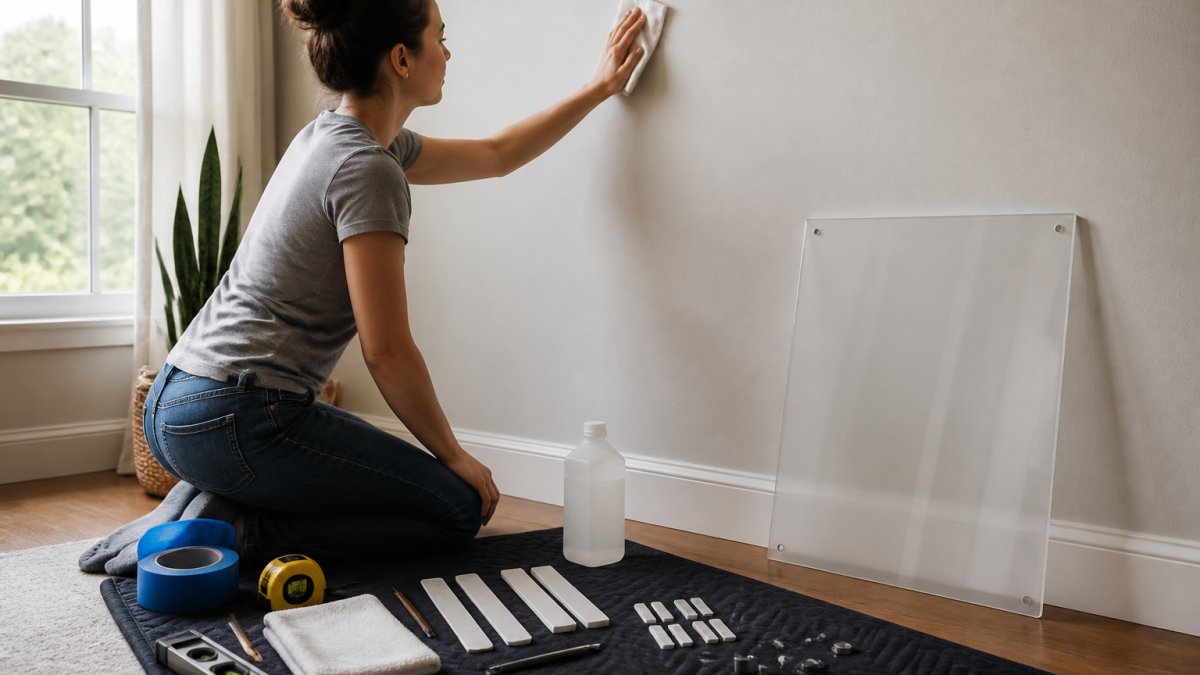
Here is the full process:
- Clean the wall. Wipe the spot with rubbing alcohol and let it dry fully. This removes dust and oils.
- Measure and mark. Use a level to draw a light pencil line where the top edge will sit.
- Attach strips to the panel. Press them firmly onto the back, holding for several seconds.
- Position the panel. Align it with your line and press it against the wall.
- Press and hold. Push firmly for the full time the package states.
- Wait before letting go. Let the adhesive cure before you trust it.
Applying Adhesive and Allowing It to Cure
Curing time is the step people rush. Adhesive needs hours to reach full strength, even if the panel feels secure right away. Many strips recommend waiting before adding any weight.
Plan your install for a day when you can leave the piece undisturbed. That wait is what keeps the panel on the wall.
Picture Ledge for Acrylic Art: The No-Adhesive, No-Hole Option
A picture ledge for acrylic art is the simplest damage-free method of all: the panel rests on a shelf instead of sticking to the wall.
These ledges mount to the wall, so they still need some attachment. But many designs lean or rest on existing molding, a mantel, or a shelf you already own.
The trade-off is placement. For a faith sign in an entryway, a ledge above a console table works well.
How to Hang Large Wall Art Safely: French Cleats and Standoff Alternatives
Large pieces need real support. Adhesive alone is risky past a certain size, no matter how good the strips are. As a working threshold, anything wider than about 24 inches or heavier than roughly 10 pounds is often considered a mechanical-mount job. Below that, adhesive can work. Above it, use hardware.
This is where French cleats and standoff hardware earn their place.
How a French Cleat Works on a Rigid Acrylic Panel
A French cleat is two interlocking brackets cut at a matching angle, one fastened to the wall and one fastened to the back of the panel.
On a frameless acrylic panel, the cleat attaches to the back surface or to a backing plate the panel ships with. The panel is rigid, so it will not flex the way a canvas does, which is good for stability but means the cleat must sit flat.
Standoff Hardware and the Floating Look
Standoff hardware uses small cylindrical spacers that hold the panel slightly off the wall, creating a shadow gap and a floating effect. Each standoff passes through a hole in the panel and anchors into the wall.
The trade-off is that standoffs require holes in both the panel and the wall. They are not a damage-free method. They are the right choice when you own the wall and want the panel to read as a single floating plane.
What Each Method Requires
| Method | Best For | Holes Needed | Removable |
|---|---|---|---|
| Adhesive strips | Small to medium panels | No | Yes |
| Picture ledge | Light to medium pieces | Maybe | Yes |
| French cleat | Large, heavy panels | Yes | Yes |
| Standoff hardware | Large statement pieces | Yes | Yes |
Safety for Larger Pieces
A large acrylic panel that falls is not just a broken piece of art. It is a rigid sheet with sharp corners and real mass, and it can injure anyone standing below. Two habits prevent that:
- Anchor mechanical hardware into studs or use wall anchors rated for well above the panel's weight. Drywall alone will not hold a large cleat.
- Have a second person help position anything large. A panel that twists during a solo install can crack at a mounting point before it ever reaches the wall.
When Drilling Is Honestly the Safer Choice
Sometimes a drill is the honest answer, and it is worth saying plainly. Very large panels, heavy pieces, and textured or delicate walls all push past what adhesive can safely hold. Textured walls are a common trap, adhesive needs a flat surface to bond, and on heavy texture strips may not grip at all.
If you rent and cannot drill, choose a smaller piece or a ledge instead. Matching the method to the wall beats forcing a method that will not hold. A Faith Before Fear sign in an entryway can work beautifully on a ledge or with strips if it is a modest size; a large statement panel in the same spot needs a cleat and a stud.
Renter-Friendly Hanging: Removal, Damage-Free Takedown, and Moving Day
Renters get the most from adhesive methods, because takedown is clean when done right. The key is slow, steady removal. Never yank a panel off the wall.
Slide a length of dental floss or fishing line behind the strip and saw downward. The adhesive stretches and releases. Pulling straight out can take paint with it.
- Warm the strip slightly to soften the adhesive
- Pull slowly and keep the angle low
- Clean any residue with a damp cloth
Do this and you keep your deposit and your art.
When Drilling Is Actually the Safer Choice
Sometimes a drill is the honest answer. Very large panels, heavy pieces, and textured or delicate walls all push past what adhesive can safely hold.
Textured walls are a common trap. Adhesive needs a flat surface to bond. On heavy texture, strips may not grip at all.
If you rent and cannot drill, choose a smaller piece or a ledge instead.
Conclusion: Match the Method to the Piece, Not the Other Way Around
The right method depends on your panel, your wall, and how long you plan to stay. Small frameless pieces do well with adhesive strips. Large ones need French cleats or standoffs.
At acrylic.studio, our frameless panels ship ready to hang, with hidden mounting hardware and a glare-free finish that looks sharp in any light. A Faith Before Fear sign fits an entryway; a Discipline First sign suits a home gym.
When you are ready, browse the collection and find the piece for your wall.
Frequently Asked Questions
Can adhesive strips hold frameless acrylic wall art?
Yes, if the strip is rated well above the piece's weight and you follow the surface prep steps. A 5-pound acrylic panel should use strips rated for 10 to 15 pounds to leave a safety margin. Clean the wall with rubbing alcohol, press firmly for 30 seconds, and wait the full cure time before mounting. Skip this method on textured walls, fresh paint under 30 days old, or in humid rooms like bathrooms.
How do I choose adhesive strips for the weight of my acrylic art?
Check the strip's stated weight limit and cut it in half for your working number. Two strips rated at 5 pounds each give you a safe load of about 5 pounds total, not 10. Pair strip count with panel size: a 24-inch acrylic panel needs at least four strips spread across the top and bottom edges so the weight distributes evenly. For anything over 15 pounds, move to a French cleat or a picture ledge.
Can I hang large acrylic art without drilling?
Sometimes, but it depends on weight and wall condition. A large frameless acrylic panel over 20 pounds on drywall with standard paint is risky with adhesive alone; the paint can peel under sustained load. Picture ledges rated for the weight are the safest no-drill option for large pieces. If the wall is textured, freshly painted, or the piece exceeds the ledge's rating, drilling into a stud or using a toggle anchor is the safer call.
When is drilling safer than using adhesive strips?
Drilling wins when the acrylic piece is heavy, when the wall is textured or has fresh paint, or when the room sees high humidity or temperature swings. Adhesive strips also fail on brick, concrete, and unfinished drywall. If your piece weighs more than 20 pounds or hangs above furniture where a fall could cause injury, use a stud-mounted French cleat. A small hole you patch later beats a cracked acrylic panel.