
Minimalist Wall Decor: Modern Home Ideas for 2026

Table of Contents
- Why Minimalist Wall Decor Works in a Modern Home
- Modern Wall Decor Ideas for Every Room
- Frameless Acrylic Wall Art: The Floating Look Explained
- Minimalist Art Prints and Print Sets That Hold a Wall
- Minimalist Canvas Wall Art: Where It Fits and Where It Doesn't
- Sizing, Spacing, and Hanging Without Clutter
- Budget Tiers: What Minimalist Wall Decor Costs
- Conclusion: Choose Fewer Pieces, Hang Them Better
- Frequently Asked Questions
Last Updated: October 7, 2026
Why Minimalist Wall Decor Works in a Modern Home
Minimalist wall decor treats the wall as architecture, not storage. One considered piece, correctly scaled, does more for a modern room than six framed prints fighting for attention.
The core principle is negative space: a bare wall frames the one thing you chose to show.
Minimalism means buying the right piece at the right size and leaving everything else alone.
Modern Wall Decor Ideas for Every Room
Modern wall decor ideas change by room because the wall's job changes: art anchors a seating group in a living room, backs the table in a dining room, and sets the first impression in an entry.
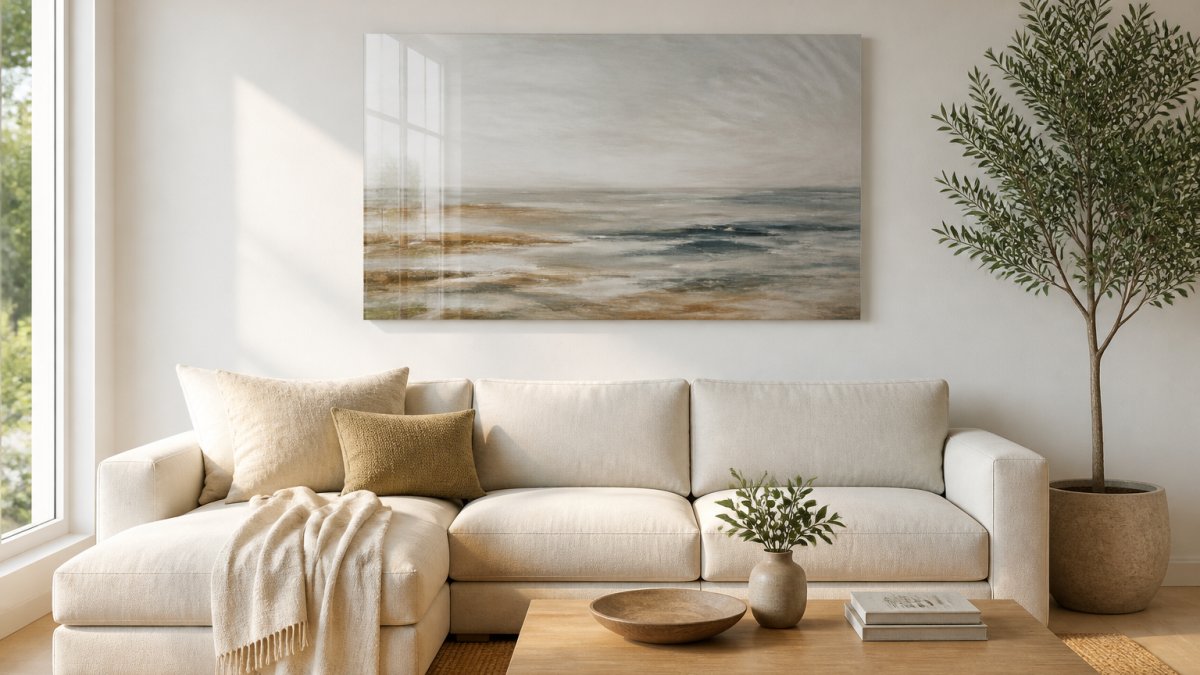
For a cohesive home, pick one visual language and repeat it: abstract and geometric artwork, neutral tones, or black-and-white photography. Bauhaus and mid-century influences work because they were built on the same restraint.
Living Room: One Large Piece Over the Sofa
One large piece over the sofa beats a cluster of small frames. Span it roughly two-thirds to three-quarters of the sofa width, centered at eye level, about 57 to 60 inches from the floor.
Horizontal suits a wide sofa; vertical suits a narrow wall or high ceiling. Leave 6 to 10 inches between the sofa back and the art. For an 84-inch sofa, aim for art 56 to 63 inches wide; if the wall is taller than 10 feet, raise the center to 60 to 63 inches.
Dining Room: Anchor the Table, Not the Wall
Art above a dining table should relate to the table, not the room. Size it to about half to two-thirds of the table width, center it on the table rather than the wall, and hang the bottom edge 30 to 36 inches above the tabletop.
A single wide horizontal piece or a matched pair works better than a tall vertical, because the table already creates a horizontal line. For a pair, treat the two as one rectangle with a 2-to-4-inch gap.

Bedroom: Smaller, Calmer Statements
Smaller pieces belong in rooms where you rest. Above a bed, keep the art narrower than the mattress, hang it 8 to 10 inches above the headboard, and center it on the mattress line, not the wall.
Calmer subject matter suits this room: soft watercolor washes, a single line, a quiet landscape. Soft inspiration for a bedroom wall might be a blush watercolor piece with floral corners and a rising sun, like our What If It Does print.

Home Office: Seated Eye Level
In a home office, place art at seated eye level so you see it without lifting your head.
Size the piece to 50 to 75 percent of the desk width. For a 60-inch desk, that is 30 to 45 inches of art. A simple chart of small daily wins, like Better Than Yesterday, keeps the message close to the work without crowding the screen.
Entryway: One Vertical Piece, One Focal Point
An entry wall is usually narrow and tall, so a single vertical piece outperforms a horizontal one. Center it at 57 to 60 inches from the floor and keep at least 4 inches of clear wall on each side. If the entry has a console or bench, treat that furniture as the ruler and follow the living-room two-thirds rule.
Hallway: Repeat, Don't Cluster
Hallways reward repetition. A row of same-size pieces at matched height and equal gaps reads as rhythm rather than a collection. Keep gaps at 1.5 to 3 inches, center the row at 57 to 60 inches, and stop before a doorway or corner. A hallway is the one place four or more pieces can work in a minimalist home, because the repetition itself is the restraint.
Frameless Acrylic Wall Art: The Floating Look Explained
Frameless acrylic wall art is a print UV-cured directly onto a solid acrylic panel with polished edges and hidden mounting hardware, so the piece floats off the wall with no frame, no paper, and no glass glare.
That construction suits minimalist rooms: a frame adds a border and visual weight, so removing it makes the image the only edge in the room, and hiding the hardware removes the last interruption.
Minimalist Art Prints and Print Sets That Hold a Wall
Minimalist art prints work as a set only when the pieces share a palette, a margin, and an alignment line. A set fails when spacing is uneven or frames differ, not when the artwork is too simple.
For a three-piece wall decor arrangement, treat the panels as one rectangle. Total width should match the two-thirds rule for the furniture below, and gaps should be equal and narrow, usually 1.5 to 3 inches.
- Two panels: hang side by side, matched height, gap equal to half a panel width
- Three panels: center panel on the wall's midline, side panels equidistant
- Four or more: split into two rows of equal height, or abandon the grid and hang one large piece instead
How to Lay Out a Set Before You Drill
Measure once on paper, then on the wall. A simple method that avoids extra holes:
- Measure the total width of the set, including gaps, and mark the left and right edges with painter's tape.
- Mark the vertical center line of the wall with a level or a laser line.
- Cut paper templates to the exact size of each panel and tape them to the wall at the intended height.
- Step back at least 8 feet and check the spacing and height from the room's main viewing position.
- Adjust the templates until the gaps look even, then transfer the marks and hang.
A set usually looks best when top edges align on a single horizontal line. Aligning centers works for mixed sizes, but takes more trial and error.
Hardware and Weight: What Holds a Set
A framed paper print and a frameless acrylic panel of the same size do not weigh the same, and the difference matters when you hang a set. Acrylic is denser than paper and glass, so three panels add up quickly.
For drywall, use a hollow-wall anchor rated for the load rather than a nail or a small picture hook. For plaster or brick, use a masonry bit and a matching anchor.
Renter-Friendly and Damage-Free Options
Renters can hang a minimalist set without drilling, but the method has limits. Adhesive strips rated for the panel weight work on smooth, painted, and sealed surfaces, but not on textured walls, fresh paint, or wallpaper, and they are a poor match for heavy acrylic panels above a certain size.
A practical approach for renters:
- Keep individual pieces small enough that the adhesive strip's weight rating covers the panel with room to spare.
- Clean the wall with isopropyl alcohol and let it dry fully before applying the strip.
- Press and hold for the full time the manufacturer specifies, then wait before hanging.
For larger pieces, a small nail or a single anchor is often the safer choice, and a tube of spackle and a matching paint sample make the repair invisible at move-out.
When a Set Beats a Single Piece
A set earns its place when the wall and the furniture below it are wide. A single piece wins when the wall is narrow, the ceiling is low, or the room already has strong elements like a large window or bold rug. Layered art can work on a deep shelf or console, but rarely on a flat wall in a minimalist room.
Minimalist Canvas Wall Art: Where It Fits and Where It Doesn't
Minimalist canvas wall art fits casual, textured rooms: a den, a hallway, a space with natural textures and organic design. The woven surface softens an image and reads warmer than a glossy panel.
If you want the same image on a surface that stays crisp and glare-free, frameless acrylic is the better match. If the room already leans rustic or coastal, canvas earns its place.
Sizing, Spacing, and Hanging Without Clutter
Sizing is the biggest factor in whether a minimalist wall looks intentional. Use the furniture below the art as your ruler, not the wall.
A simple framework we recommend:
| Wall situation | Art width | Height from floor | Gap rule |
|---|---|---|---|
| Above a sofa | 2/3 to 3/4 of sofa width | Center at 57-60 in | 6-10 in above sofa back |
| Above a bed | Narrower than mattress | 8-10 in above headboard | Center on mattress line |
| Above a desk | 50-75% of desk width | Seated eye level | 6-8 in above desk top |
| Narrow wall | Single vertical piece | Center at 57-60 in | Keep 4 in from each edge |
For renters, adhesive strips rated for the panel weight avoid drilling, and most remove cleanly when you move. Check the strip's weight rating against the piece before you commit.
Budget Tiers: What Minimalist Wall Decor Costs
Budget tiers for minimalist wall decor break into three rough bands, and the differences come down to material and finish rather than size.
- Entry tier: unframed paper posters and small prints, typically the least expensive per piece, but they need a frame and they show glare under direct light.
- Mid tier: framed prints and canvas, which add a border or a textured surface and a moderate cost per piece.
- Premium tier: frameless acrylic, where the panel, the UV print, and the hidden mount are built into one finished object that arrives ready to hang.
At acrylic.studio, every acrylic print is $140.00, made to order in our US studio and ready to hang on arrival. That single price covers the panel, the print, and the mounting hardware, so there is no separate frame to buy.
Conclusion: Choose Fewer Pieces, Hang Them Better
The challenge with minimalist wall decor is restraint. It is easy to keep adding until the wall feels busy, and hard to stop at one piece and trust it.
That is what we build at acrylic.studio. Our frameless acrylic prints are UV printed directly onto optical-grade acrylic glass, so there is no paper and no glass glare, and the hidden mounting hardware gives the floating effect that makes a single piece read as intentional.
Shop All and start with one wall, one piece, and the right measurements.
Frequently Asked Questions
What are the current wall decor trends for modern homes?
Neutral tones, negative space, and one strong focal piece per wall are driving modern interiors right now. Black-and-white artwork, abstract and geometric design, and Bauhaus or mid-century inspired line work all fit this direction. Frameless acrylic wall art is gaining ground because it sits flush against the wall and reads as part of the room rather than an object added to it. The through-line is restraint: fewer pieces, larger scale, and colors pulled from the room's existing palette.
How do you decorate a wall in a minimalist home without it feeling empty?
Scale does the work that quantity usually does. A single piece sized to about two-thirds the width of the furniture below it fills the wall without clutter. Center it 57 to 60 inches from the floor on center, or hang it 6 to 10 inches above a sofa or headboard. If the wall still reads bare, add texture instead of more art: a woven hanging, a wall sculpture, or a plant. One piece plus one texture is enough for most walls.
What size wall art should I choose for a living room or bedroom?
Measure the furniture the art will sit above, then aim for artwork that spans 60 to 75 percent of that width. Above a 72-inch sofa, that means a piece roughly 48 to 54 inches wide. For a bedroom, center the art over the bed and leave 6 to 10 inches of wall between the top of the headboard and the bottom edge of the frame. In a home office, a smaller 16-by-20-inch piece above the desk is usually enough.
Can I hang minimalist wall decor in a rental without damaging the walls?
Yes. Adhesive picture hangers rated for the weight of your piece work on painted drywall and come off with a slow pull, which is what most renters use. Check the weight rating before you buy: a lightweight acrylic print is far easier to hang this way than a framed canvas. Keep the piece under the hanger's stated limit, clean the wall with rubbing alcohol first, and press for the full cure time before hanging. Acrylic pieces also weigh less than glass-framed art at the same size.
Is frameless acrylic wall art worth it compared to canvas?
It depends on the look you want. Canvas has visible texture and a soft edge; acrylic is smooth, glossy, and sits flush to the wall with a floating effect. Acrylic also resists glare and holds color well because the image is UV printed directly onto the surface rather than onto paper behind glass. At acrylic.studio, prints start at $140.00, made to order and ready to hang on arrival. Choose acrylic for a clean modern finish, canvas for a warmer, more traditional feel.